
Marengo County Arrest Records and Charges
Marengo County arrest records document law-enforcement action and may begin with the arresting agency and booking process. The Sheriff's Office says its work includes apprehending people, identifying and preserving evidence, and maintaining criminal records. Court charge records start later, when an accusation is placed before District or Circuit Court. The Circuit Clerk then maintains the criminal case file, including the charging instrument and its later status.
No official online Marengo jail roster, booking database, active-warrant list, or sheriff app was found. The state county-official lookup lists Robert Alston as Sheriff and Darren Glass as Circuit Clerk. Current custody or booking questions go to the Sheriff's Office contact channel at (334) 295-4208 or 101 Dunn Street in Linden. State prison searches through ADOC cover currently incarcerated state inmates, not Marengo pretrial detention. The full Marengo criminal court record supplies the later pleas, hearings, outcome, and sentence.
The official sheriff role page provides the law-enforcement context for arrest records.

The image connects the sheriff's record-maintenance role to the arrest side while leaving formal court charges with the prosecutor and clerk.
Find Marengo Arrest Records and Charges
Use the access channel that matches the record. Call or visit the Marengo County Sheriff's Office for county arrest, booking, or current custody facts because it publishes no searchable roster. Use AlacourtACCESS or Just One Look for Alabama trial-court criminal records by name or case number. Use the free Marengo docket portal for date-based settings, then call the Circuit Clerk at (334) 295-2224 if a case is missing. Municipal charges can remain with the issuing city court.
- Identify whether the need concerns an arrest, current custody, a filed charge, or the final case outcome.
- Contact the sheriff for the arrest side or search Just One Look for a filed court case.
- Confirm the person, Marengo venue, court level, and case number before reading charges.
- Review every count for its description, statute reference, filing document, and current status.
- Read the disposition and sentence before describing any charge as a conviction.
An empty portal result can reflect spelling, timing, restricted access, older records, or a non-electronic file. It does not prove no arrest or charge exists. ALEA's sex-offender registry is also not a general arrest database. It serves registration information under its own rules. ADOC is limited to people in current state custody and states that historical data is unavailable online.
Marengo Charges After an Arrest
Arrest does not freeze the accusation in its first form. Police may arrest based on an alleged offense, but the prosecutor decides what accusation to pursue in court. Rachel M. England is the District Attorney for the 17th Judicial Circuit, which serves Marengo, Greene, and Sumter Counties. A complaint can begin a lower-level case. An information is a prosecutor-filed charging document where procedure allows it. An indictment is returned by a grand jury and is associated with felony prosecution. The filed document, not the booking label alone, defines the court charge at that stage.
| Point | Complaint | Information | Indictment |
|---|---|---|---|
| Source | Officer or prosecutor | Prosecutor | Grand jury |
| Function | States the alleged offense and begins many cases | Formally states a prosecutor-filed charge where allowed | States the grand jury's formal accusation |
| Record Effect | Creates a filed charge | Creates or formalizes a filed charge | Creates the felony charging record |
One arrest can produce several counts, and those counts can proceed in different ways. A preliminary District Court matter can also be followed by a Circuit Court felony case. Match the charge to its current case number and court rather than merge every entry tied to the defendant.
Marengo Court Charge Status
Charge status is a snapshot of what the court record says now. Pending means the count has not reached a final result. An amended or reduced charge replaces or changes part of the accusation. Dismissed means the court case ended on that count without conviction. Nolle prosequi records the prosecutor's decision not to pursue the count at that time. Acquittal is a not-guilty result after trial. Each term has a distinct effect.
| Status | What It Means |
|---|---|
| Pending | No final disposition has been entered for the charge. |
| Amended | The wording, code, degree, or other part of the accusation changed. |
| Reduced | The case proceeds on a lower-level charge. |
| Dismissed | The charge ended without a conviction on that count. |
| Nolle Prosequi | The prosecutor chose not to proceed at that time. |
| Acquitted | The fact finder returned a not-guilty result. |
Because status can change after a hearing or prosecutor filing, the newest docket entry and filed order should be checked before the charge is summarized.
Marengo Charges vs. Convictions
Being arrested or charged is not a finding of guilt. A charge records an accusation. A conviction requires a guilty plea or adjudication. Court charges after arrest can be dismissed, reduced, or end in acquittal. Searchers must read the disposition for each count and should avoid summarizing the most serious original accusation as the final outcome.
| Charge | Conviction | |
|---|---|---|
| Stage | Accusation | Verdict or plea |
| Burden of Proof | Probable cause | Beyond reasonable doubt |
| Meaning | Alleged offense | Guilt established |
| Outcome | May change or end without guilt | Leads to sentence and possible appeal |
Arrest records and court charges remain relevant to case history, but the disposition is the record that answers whether guilt was established.
Marengo Sealed vs. Expunged Charges
Sealing restricts public inspection under a court order or specific law. Expungement is the Alabama petition process that restricts public dissemination of eligible arrest and charge records after an order is granted. Section 15-27-1 applies to eligible non-felony and similar matters, while Section 15-27-2 governs certain felony records. Authorized access can remain.
| Sealed | Expunged | |
|---|---|---|
| Public Visibility | Limited by law or order | Restricted after an expungement order |
| Agency Access | May remain for authorized users | May remain where Alabama law permits |
| Basis | Specific confidentiality rule or court action | Petition and statutory eligibility |
Neither process is self-executing. A person must follow the governing court and statutory procedure, and the clerk cannot provide an eligibility opinion.
Marengo Charge Codes and Severity
A charge record may include the offense description and statute reference when available. Felony and misdemeanor labels signal the class of prosecution, but the actual statute, degree, and filed document control. One arrest may produce several charges with separate codes and separate results. Traffic and municipal ordinance matters can have their own case routes. Do not infer punishment solely from an abbreviated label, and do not assume a booking description matches the final filed count.
Warrant and bond entries are related but different. A warrant authorizes enforcement, while bond is security or a release promise set while a case is pending. The Circuit Clerk lists Warrants as a record division. The sheriff handles service and custody issues. No official Marengo public warrant search was located, so a pending case question goes to the clerk and a law-enforcement service question goes to the sheriff.
Statewide Marengo Record Checks
The ALEA Sex Offender Registry service links to the Community Information Center. It is a specialized registry, not a full arrest or criminal-history search. Juvenile, youthful-offender, and out-of-state status can also affect what registry information is publicly disseminated under its rules.
The state service image shows the official route for registry information without turning that tool into a general charge database.
The official ALEA Community Information Center provides the search portal and its public-use warnings.
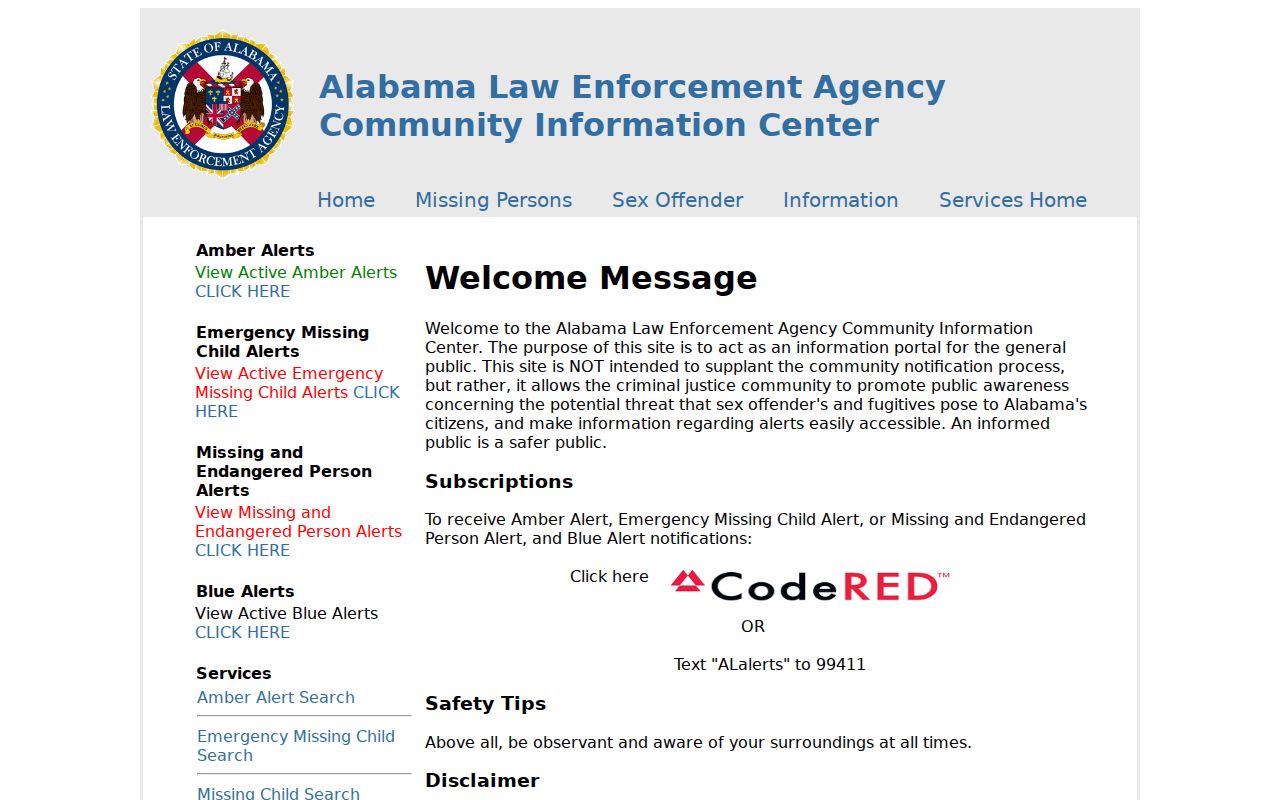
The captured portal marks the statewide registry channel that is separate from Marengo court cases, sheriff booking records, and ADOC custody.
Registry information should be read with the portal's disclaimer and should not be treated as proof of a new arrest, pending charge, or current jail custody.
Use Marengo Charge Records Carefully
A public court lookup can help follow a case, but it is not a consumer report and may be incomplete or out of date. Name-only matches can join unrelated people. Arrest records can lack later court action. Charge lists can omit amendments or final outcomes. Verify identity, court, case number, disposition, and the originating office before drawing a conclusion.
Important: These records may not be used for FCRA-regulated credit, employment, tenant, insurance, or other consumer-reporting decisions.
Restricted Marengo County Charge Records
Juvenile records are confidential under Code of Alabama Section 12-15-133 and should not be promised through ordinary public search. Sealed and expunged charges are also withheld from normal results. Personal identifiers can be redacted, and active investigative records may remain with law enforcement instead of the public court file. A person seeking expungement should identify the arresting agency, case number, charge, and outcome, then use official forms or counsel because the Circuit Clerk cannot decide eligibility.
Authorized parties should contact the holding court about access requirements and bring proof of identity or authority if the office requests it.